Up the Fujinomiya trail through fog and volcanic gravel, past a bout of altitude sickness to the summit, then a descent that was harder than the climb.
Adventurers, nature enthusiasts, hikers, and all sorts of other people seek the thrill of conquering mountains in every corner of the globe. Just like how the Rocky Mountains, Himalayan Range, the Andes, and European Alps captivate thousands of hikers and mountaineers, Japan proudly presents the legendary Mount Fuji.
Japan is a country brimming with captivating tourist attractions. From the bustling streets of Tokyo to the quiet and calming Kyoto, there is never a shortage of activities to do in Japan. Throughout all this, Mount Fuji holds a special place of prominence as the highest point in the country and Japan’s true crown jewel.
Known as Fujisan by locals, Mount Fuji symbolizes not only Japan’s natural beauty but also its cultural and spiritual heritage. For example, Mount Fuji is worshiped as a sacred god or spirit (kami) in the Shinto religion, which is a primary religion of Japan. Its volcanic activity symbolizes the earth, sky, and fire. For followers of this religion, climbing its slopes is considered an act of pilgrimage and faith. However, Mount Fuji also calls out to all those who can’t get enough of the mountains and nature.
Standing at a height of 3,776 meters, or 12,389 feet, Mount Fuji stands as the highest mountain and point in Japan. It is located about 60 miles away from Japan’s capital city, Tokyo. However, several small towns such as Fuji Kawaguchiko and Fuji Yoshida are located nearby. We stayed in Fuji Kawaguchiko for the night before we began our big climb. It is less than an hour drive from the base of Mount Fuji.
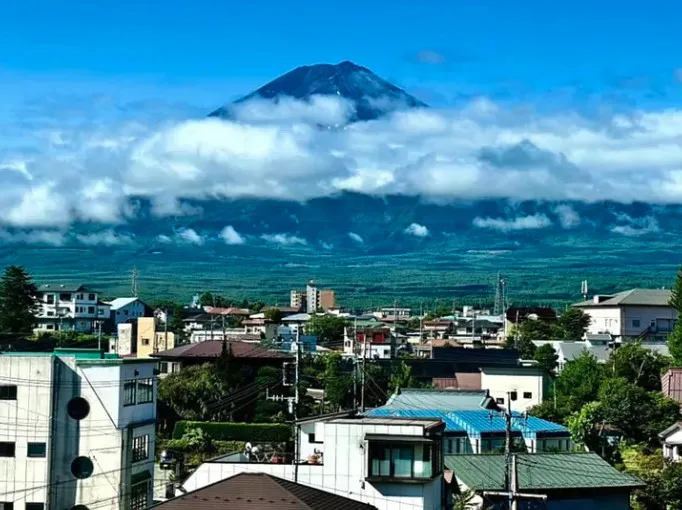 This is the view of the intimidating Mount Fuji from our hotel!
However, it is important to remember that there are four trails that can lead you to the summit of Mount Fuji. The first trail, Yoshida, is the most popular and busiest route, as it is known for being more accessible than the other trails. It is a 8.6 mile round-trip, with an elevation gain of 4,842 feet. The second trail, Subashiri, is often considered the easiest route as it offers a gradual ascent and a moderate slope upwards compared to the other trails, which are significantly steeper. It is a 7.1 mile round-trip and has an elevation gain of 5,744 feet.
The third trail, Gotemba, is the most unpopular route to the summit. This is because compared to the other trails, it is longer. With an elevation gain of a whopping 7,759 feet, it is a 12.3 mile round trip. However, it is a pretty gentle slope upwards, which makes it slightly easier than the last trail mentioned — Fujinomiya. However, some people may believe this is the most difficult and physically demanding trail. We were about to find out!
And finally, we come to the Fujinomiya trail, the second least popular. It is slightly shorter than the other trails (with a total elevation gain of 4,450 feet and a 5.1 mile round-trip). However, although the elevation and length may not look too harsh, it is considered the most difficult trail on Fuji due to its steep sections, technical climbing, and extremely rugged terrain based off of volcanic ash and gravel. This was the trail my Dad and I (accompanied by our guide, Masa), used to reach the summit of Mount Fuji.
11 AM
We began the hike at the 5th Station at around 11 AM. Within minutes of starting the hike, we saw a dense fog coming in blurring any views. We reached the 6th Station relatively quickly as my dad and I kept a blistering pace. However, we were just about getting started. We still had to reach the 7th, 8th, and 9th Stations before we reached the Mountain Hut where we would be spending the night to rest. A good chunk of our initial ascent was through very slippery volcanic gravel in a fog with very low visibility, which took a quiet resilience that one can only really experience in extreme endurance activities.
Finally, we got a break from the fog when we reached above 7500 feet. It started to become sweltering outside as the sun shone brightly in the sky. Unlike the 6th Station, which was a short distance away from the beginning of the trail, the 7th Station was around 45 minutes away from the 6th Station. Along the way, we didn’t pause much as we had the plan to stop only once we reached the Station ahead of us. However, we continued to drink quite a lot of water to prevent the possibility of AMS (Acute Mountaineering Sickness), which is caused by the reduced air pressure and lower oxygen levels at higher altitudes.
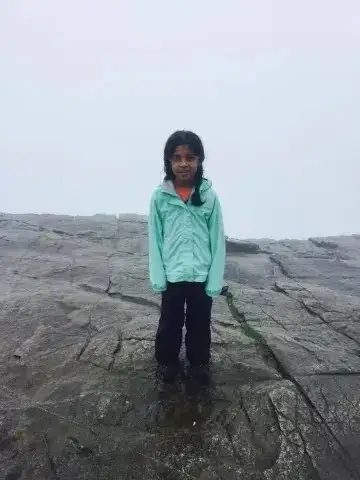
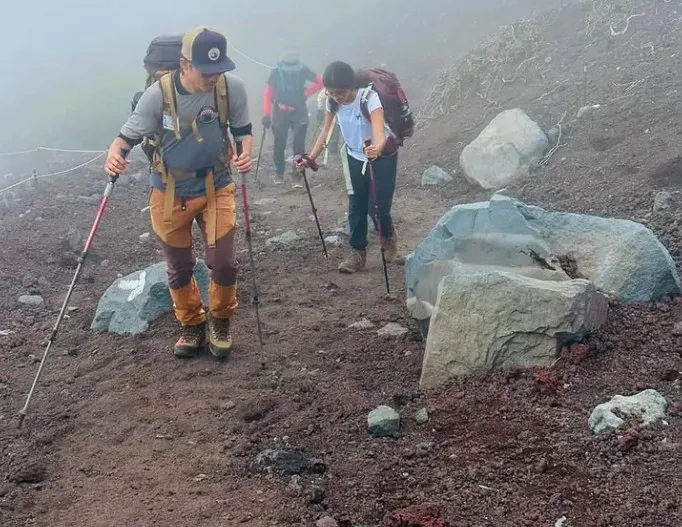 In this photo, you can see just how foggy it was. After this photo was taken, it only got worse!
We reached the 7th Station in around 30 minutes, and the 8th Station around 40 minutes after that. Clearly, we were continuing to ascend at a rapid pace— as per our guide Masa. At this rate, we would reach the Mountain Hut several hours before planned, which was good as it would give us more time to rest before the final push to the summit. As we climbed higher, we spotted patches of snow as it was pre-season.
12:30 PM
However, things began to take a turn for the worse when we were about 15 minutes after passing the 8th Station. My stomach began to feel extremely heavy, which was abnormal as I had only had a small amount of water and a few energy gummies at that point. The only thing that could have been bothering me was my heavy breakfast. However, I decided to push through in hopes that it would eventually subside.
It didn’t. My pace slowed down considerably and I had to take frequent breaks. In the risk of worsening my stomach’s condition, I refused to drink or eat anything as I didn’t want my stomach to feel even worse than it already did. With dehydration as an additional factor I was facing, my state on the mountain became even worse. I could feel a creeping fatigue and a sense of weariness started to invade my legs.
Seeing the clear nausea and weakness I was feeling, my Dad realized this was a clear sign of AMS and suggested that I try and forcefully throw up, hoping expelling the food would alleviate my discomfort. Thankfully, it did, and I realized that the eggs I had eaten at my hotel that morning was the root cause of the issue. Although I did not feel completely well, I felt well enough to continue the hike to the 9th Station.
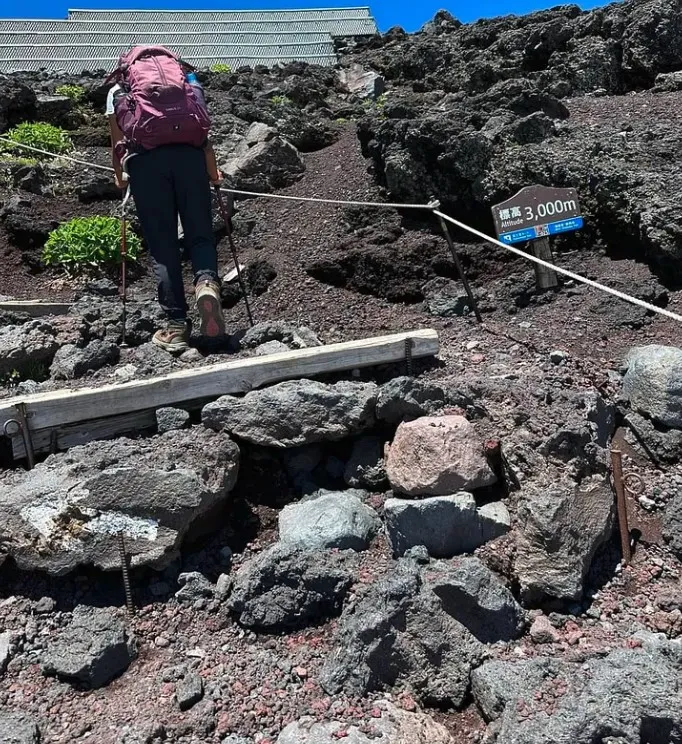 This was me shortly after throwing up. In the background, you can see the 9th Station approaching— just a couple feet away.
Climbing with AMS is nearly impossible for most people. With a deadly array of symptoms such as headaches, nausea, vomiting, loss of appetite, and dizziness, many people are forced to turn back if they begin to feel any of these symptoms as they will only worsen the higher you climb. Oftentimes, it is just too difficult for them to continue their respective climb.
However, after drinking a decent amount of water and snacking on some trail mix, I summoned my mental fortitude and physical tenacity to push through the extreme fatigue I and was determined to powered through! Giving up was not on my agenda.
As Fujinomiya was also a very technical route, upon reaching the 9th Station, we had to scramble through a series of rugged rocks while persistently climbing on steep paths with 40–45 degree inclines.
2:30 PM
We finally reached the Mountain Hut at approximately 2:30 PM. It was great to finally get a proper break and I immediately decided to kick off my boots and sleep, as clearly I was completely wiped out. This ‘advanced base camp’ was at 10,800 feet. We decided to spend a few hours resting here to let me recover from AMS.
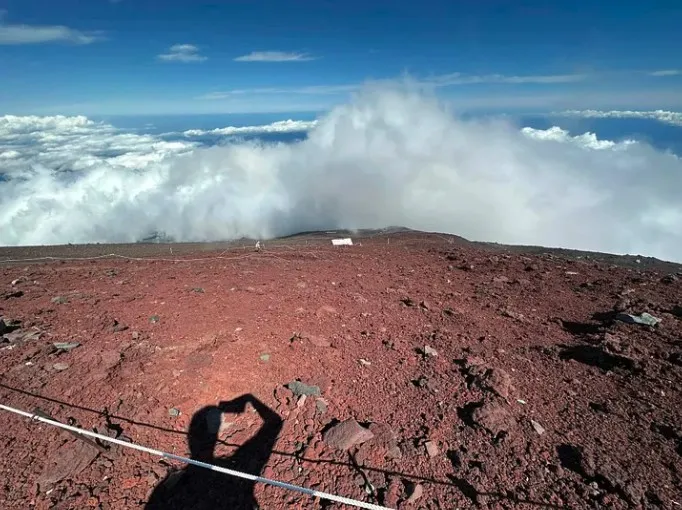 This was the view from the Mountain Hut.
5:30 PM
I awoke at 5:30 due to lots of noise in the Mountain Hut (as it was public and shared between 10+ people). Food — just simple miso soup, pickles, and rice — was provided. After eating a proper meal and rehydrating, my nausea was gone. But then came my next problem: headaches.
Before I could go to bed, I began to feel a clear pounding headache coming along. Now, it was clear that I was facing the classic AMS symptoms. And — it is classic knowledge that if you come down with a headache on a mountain at high altitudes, it is very rare for it to go away. Knowing this, my Dad and guide encouraged me to be honest with my symptoms and told me that if the symptoms persisted, we would have to turn back if I wanted to or not.
That night, I swallowed some tylenol and drank more water before going to bed. It was the only thing I could do in hopes of improving my headache for tomorrow. Otherwise, we would have to turn back, despite how close we were to reaching the summit. However, only time would tell.
2:30 AM
My Dad woke me up at around 2:30 to begin our final climb to the summit as planned. I felt much better; however I was a bit nervous as I looked outside and saw how dark it was — pitch black. After expressing my concerns, we decided to leave at 4:30 AM instead.
4:30 AM
No longer overcome with symptoms of AMS, I felt strong enough to begin our climb. We snacked on some biscuits and granola bars. The plan was to reach the summit and then arrive at the Mountain Hut around 7:30 AM to eat a light breakfast before beginning the final climb down.
Dawn was breaking as we began to climb the last 1,400 feet remaining. It was extremely cold and so we had to wear several more layers than the previous day — multiple jackets, hats, and gloves. Within twenty minutes, we had already reached an abandoned 11th Station and climbed around 300 feet. The last twenty minutes to reach the summit was an excruciating climb. For a majority of the trail, the terrain was so challenging that for every two steps we took, we slipped one step. It was a constant back-and-forth effort.
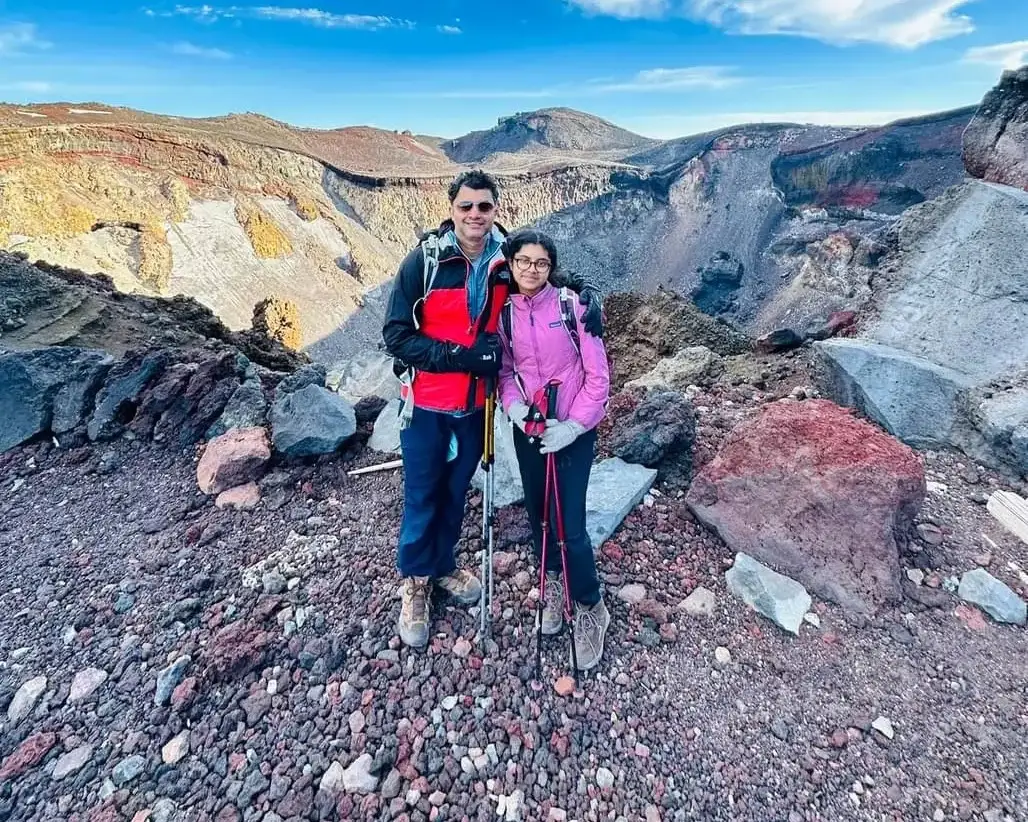
The moment I reached the summit felt exhilarating, partly because all the hard work I had put into this climb had finally paid off. The summit is a beautiful and colorful crater which was formed by previous volcanic activity. The area is covered with volcanic ash and rocks.
After snapping a significant amount of photos as memories, we rehydrated and re-charged on some energy gummies before heading down. Although we were celebrating our victory, we still had to be careful on the way down so we did not make a stupid mistake somewhere and hurt ourselves. When in a challenging and potentially hazardous environment like Mount Fuji, it’s very easy to fall or twist an ankle when you’re unfocused.
Returning back to the Mountain Hut definitely took some stress out on my calves and knees, but was easier for me and gave me a well-needed break from the constant incline I faced on the way up. We spent around 90 minutes in the Mountain Hut where we ate the same food as the previous night — miso soup, pickles, and rice.
8:30 AM
We began our descent at around 8:30 AM. Instead of taking the Fujinomiya trail on the way back, our guide thought it would be best to take the Gotemba trail down, which would eventually cross with the Fujinomiya trail at around the last hour of the hike. He did this as he believed that the terrain of the Gotemba trail would be easier for us rather than climbing down the rocky Fujinomiya trail. The terrain on Gotemba ranges from deep gravel to unstable medium-sized and massive rocks and is very difficult to traverse as it tends to be slippery and can even shift underfoot.
However, he was wrong. For both my Dad and I, the trail required tremendous energy even though it seems deceptively easy. Our feet kept slipping and our knees kept buckling. Later, we both agreed that we would have preferred to take the Fujinomiya trail back down.
There were many times on the way down where I felt like my legs would collapse from exhaustion at any given point, but I knew I had to persevere and continue cautiously. Mount Fuji taught me that the descent can be just as demanding as the ascent, and it’s essential to stay focused at all times.
Climbing Mount Fuji was an extremely proud moment for me. It was a climb that demanded months of preparation and dedication. It taught me lessons that I will use constantly when on the slopes, but other more important ones like the importance of persevering through challenges that stand in the way of your goals. These are lessons I will use throughout my day-to-day life in New York. Besides for this, Mount Fuji was extremely beautiful and a climb I will definitely remember forever!